Thursday, February 18, 2010

Choosing Your Seeds

So many to choose from!  I think I'll plant a little of everything!   The majority of my seeds are herbs, and vegetables, but I do have a few annuals and perennials in my collection also.  This is just my seeds that I purchased.  I also have collected lots of seeds from my plants last year that I gathered in the fall.  They came in handy for a few of my customers who are always looking for seeds for science projects that I was able to help them out with.  
Amoung my collection I came upon Sweet Pea seeds.  They are large seeds as you can see, so they will be easy to sow.    So lets get started.   I  turn to an old "Fine Gardening" 10th Anniversary Issue magazine from 1998 that had a wonderful article entitled "Seed Starting Made Easy".   We'll see!       First thing I've learned is that you can "trick" your seeds to get them to germinate faster.  Check the packaging as to germination guidelines.   Most seeds can be soaked for 24 hours which will expose the seed embryo to moisture, causing it to soften and plump up.  Simply pour hot tap water into a shallow container and empty the packet of seeds into the water.  Spread them out and allow them to soak for no more than 24 hours.  Be sure you're ready to plant them when they come out of the water, or they might rot.  This is, by far, the easiest method to do.  The other two methods are "stratification" and "scarification"
"Stratification" - tricking the seeds into thinking they are experiencing winter by supplying them with a period of moist cold.  How do you do this?   Presoak your seeds as mentioned above.  Fill a zip-lock plastic sandwich bag with half way with moist seed starting mix and place the seeds on top of the soil.  Add another inch of soil mixture, close it up and place it in the refrigerater.  Check the bag weekly for signs of sprouting.  When you see the roots emerging, carefully remove them and place them in into pots in a warm spot and treat them as you would other seedlings. 
"Scarification" on the other hand is the process of nicking the seed coat with a knife or sandpaper so that moisture can get to the seed embryo quicker.  Obviously, these seeds are larger in size!  You can use your fingernail to dent it.  If the seed is too large or thick, you can use a knife or rat-tail file.  Don't be too zealous, you only need to remove just a small slice or section of the seed coat.  Another method of nicking the seed is place a piece of sandpaper in a jar so that it covers the entire jar.  Place the seeds in the jar, close the lid and start shaking the jar so the seeds rub against it and get abraded as you shake it vigorously.    You MUST do this just prior to planting or you risk the seeds drying out. 
This is a lot to take in, but I'm going one step at a time. 

Wednesday, February 17, 2010

Start Your 2010 Garden Soon With Seeds...


If you're thinking about growing your own vegetables or perennials this year, you should try planning your garden by starting your own seeds.  It's not as hard as you think.  I tried my luck with some vegetables last year and surprisingly had tremendous luck.  The hardest part is keeping critters from eating them, and keeping them bug free and fungus free throughout the season!! 

Now that Valentine's Day is over, I will be concentrating on starting my seeds....follow along with me as we go step by step through the process and learn together what works, and what doesn't. 

The first thing you need to do is choose which plants or veggies you want to grow.  Be sure to choose plants that are compatible to your growing zones.   You must read the instructions on the packages as to when you should start the seeds because all germination times vary according to the plant.  Some seeds you can sow directly into the garden...others you start weeks before the frost-free date in your area.  Just read the entire package!

How do you find the Frost-Free Date (the last date for which you can expect to receive frost)  for your area?   Check the Farmer's Almanac Website .   In Cincinnati, our Frost-Free Date is April 13th.  However, in reality, I was always taught that you don't ever plant before Mother's Day!   Well, you can, but be prepared to cover tender plants or annuals with sheets (not plastic)  if the temperature drops below the 38 degree mark, and it probably will! 

I purchased a lot of unusual herbs last year that I am excited to try.  Valerian root and Ginseng are two I'm anxious to plant...along with cumin, angelica, dill, basil, and lots of other goodies.    So get out your garden gloves and get ready to get your hands in the dirt! 

My Baptisia (False Indigo)

Thursday, September 24, 2009

Is Your "Local" Florist Really Local?


In the "Online" world today, convenience is where it's at. Ordering flowers online is a very convenient way to send your sentiments across the miles. But when you order online, do you know exactly where your flowers will be coming from? Are you ordering from a "Local" Florist, or are you ordering from what we in the floral business refer to as "ORDER TAKERS". Let me explain....


In a nutshell, "Order Takers" are people who sit in a cubicle and accept your call, or your order. They, in return, forward your order on to an actual florist who may, or may not be, in the same city as the recipient. When you check out, you will be paying a "Service Fee" of anywhere from $15 to $25 for this convenience. You may think that this is part of the delivery fee, but it's not. That money is money they keep - it does not get shared with the florist. I'm going to reveal to you how your order to an "Order Taker" is handled.

You want to send flowers fast and conveniently, so you type in your search field, "Florists in Cincinnati", or "Florists in Hyde Park, Cincinnati". Your results bring up all the popular order takers. (They can spend more money on the advertising to get them listed at the top of the search page because they make the most money taking orders. I won't list the names, but you probably know who they are.)
You want to spend $50 for the flowers. Here's how your order will be filled.

  • $50.00 Flowers
  • 15.00 Service Fee
  • 4.24 Tax
  • -------
  • $69.24 Total

Here's what actually happens.

They will forward the order via wire service or by phone. They send the florist $50.00. From that $50, they allow the florist to use $7.00 for their delivery fee. That makes your $50 flower order worth $43. From the $50, they also take back 27% from the florist in wire fees but still expect them to fill the order to the $50 value. Here's what the florist has to work with:
  • $50.00 Flowers
  • -7.00 Delivery Allowance (Many florist's delivery fees are $10 or more)
  • - 13.50 Wire Fees
  • --------
  • $29.50 What your order is really worth.

Click on this image to check out this article at "aboutflowers.com"


As florists, it IS necessary to be members of a wire service in order to offer worldwide delivery to our customers. There are fees associated with this service, but many florists such as myself, will waive the service fee if possible. Your results will be much better if you order through an actual florist, one who has an actual storefront with flowers in it, and is not sitting in a cubicle waiting for your call.

I tell you all this because I think it is absolutely necessary to educate consumers on how their money is being spent, especially in our economy, and how important it is to use your LOCAL businesses who can provide you with the personal service and the quality products you deserve.
Add your Local florist to your browser's "Favorites" list, and next time you need to send flowers across the street, or the world, let them handle it. You will get more "Bang For Your Buck" if you do!
Thanks for listening!


Saturday, September 5, 2009

How To Have A "GREEN" Christmas This Year!


As the fall is upon us, we in the retail industry turn our thoughts to the upcoming Christmas season. I, for one, HATE to walk in a store in September and see Christmas displays everywhere!However........when you're the "Little Guy" amongst the "Big Stores", if you don't jump on the boat when they do, you miss it!

Now, you won't walk in to my store, Hyde Park Floral and Garden, in September and see Christmas displays everywhere - I refuse to put them out too soon! But you can bet that it's in the works!

First on the agenda, is letting everyone know that we are only purchasing FRESH trees, wreaths, garlands and greens this year in an effort to contribute to the best Environmental Choice for our customers. (Not to say that you won't find artificial decorations, because we do have lots left over from last year, so we have to try to discount them to try to deplete that inventory.)

Here's some facts I discovered at the National Christmas Tree Association website that brings me to this choice:

Real Christmas Trees ... The Environmental Choice

During the 2005 holiday season, 32.8 million Real Christmas Trees were purchased for display
in homes nationwide. These consumers made the choice of a Real Tree for a variety of reasons
– the fresh scent, the beauty of the evergreen, the traditions of the holidays – but what
they may not have known is that a Real Tree is also a wise environmental choice.
Here are some facts to consider:


# Around 98% of Real Christmas Trees are grown on farms throughout all 50 states and Canada. These trees are planted to be harvested, just as corn is cultivated for harvest.


# The Christmas Tree industry in the United States employs more than 100,000 Americans
(part- and full-time). Meanwhile, 85% of fake trees are made by factory workers in China.


# Every acre of Christmas Trees grown produces the daily oxygen requirement for 18 people.
With approximately 500,000 million acres of trees, 9 million people a day are supplied with oxygen thanks to these trees.


# Real Christmas Trees support life by absorbing carbon dioxide and other greenhouse
gases; they also stabilize soil, protect water supplies and provide a refuge for wildlife.


# For each Real Christmas Tree harvested, up to three new seedlings are planted in its place.
In 2006, more than 42 million new seedlings will be planted by Christmas Tree farmers all
over the United States. And after the holidays, a Real Christmas Tree is the only choice that is completely recyclable. Artificial trees typically end up in landfills, where they will remain for centuries after disposal.


# In a national survey, 69% of consumers who used a Real Tree said they recycled theirs in a
community program.


# Real Christmas Trees are recycled for five main types of large-scale uses for post-harvest
trees. These are:
1) Chipping (chippings are used for various things from mulch to hiking trails)
2) Beachfront erosion prevention
3) Lake and river shoreline stabilization
4) Fish habitat
5) River delta sedimentation management


OUR CHRISTMAS TREES AND GREENS WILL BE IN THE WEEKEND BEFORE THANKSGIVING. SIZES FROM 6' UP TO 11'.


YOU CAN PRE-ORDER YOUR TREE BY GOING TO OUR "CHRISTMAS TREES & GREENS" PAGE ON OUR WEBSITE, http://www.hydeparkfloral.com/


OR JUST CALL OUR SHOP AT 871-9888.


WE WILL OFFER DELIVERY, SET-UP AND REMOVAL


Thursday, August 27, 2009

Lazy Days Of Summer....


As I walk around my garden, I can't help but think how short our growing season really is. There is so much more I wanted to plant, but time ran out. It is already the end of August and many of my perennials are beginning to slowly die back and get ready to prepare for the coming winter. It saddens me so. The annuals that have survived the crazy weather we have had here in Cincinnati are finally showing signs of surrender. Sadly, I'll let them fade to make way for a whole new crop because I realize that fall is upon us, and with it comes a whole new splash of color. The trees are beginning to put on their fabulous display. Make new room in the garden for mums, pansies, ornamental peppers, ornamental cabbage and kale. The last "harrah" before snow greets us again.


Take time to sit back and relax in your favorite spot in your garden and read a book while you listen to the birds singing. Take it all in while you can, because soon you'll be hovered inside nestled in an afghan sitting by a fire, looking out at what use to be your garden and dreaming about what you want to plant in the spring.


I have discovered a fabulous new garden magazine that is just perfect for that moment. The name of it is Green Prints. Its a wonderful collection of short stories by gardeners, and beautiful illustrations by various artists. The best thing about this little book is, you don't have to hunt for the content in between the advertisements. Please check out their website and read some of the sample stories there. I think you'll be pleasantly surprised!


Enjoy!


Wednesday, August 5, 2009

Please Support Your Local Small Businesses!


It saddens me to drive through my city and see empty retail shops that once housed businesses that just couldn't survive the slump in this economy. Take a look around your city. Are the local hardware stores, beauty shops, dress shops, candy stores, shoe repair shops, florists, and many other individual small businesses still there? Can you remember the last time you visited one of these shops? How much further is this going to go? Will you be satisfied to shop only at the big box stores?

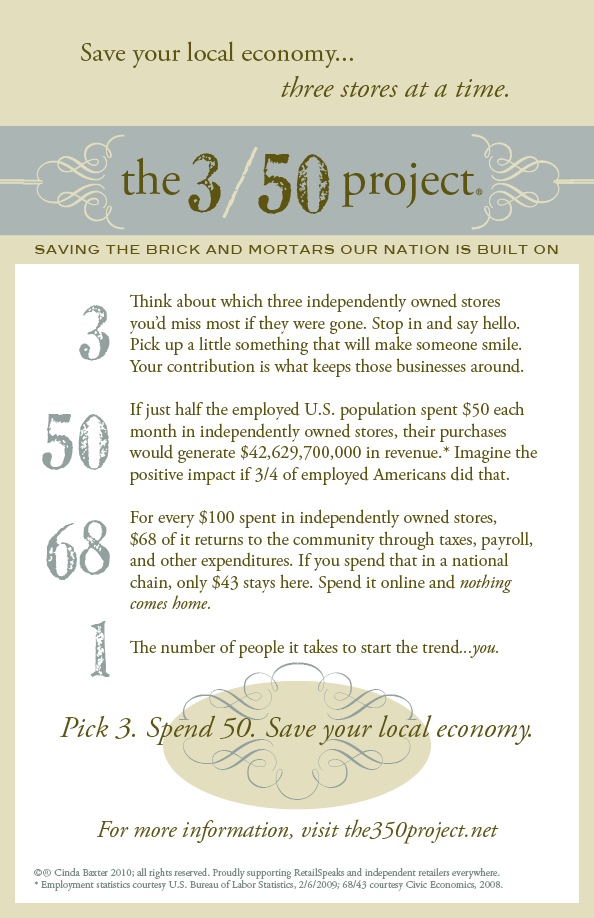
As one of those small businesses, I urge everyone to stand up and take part in The 3/50 Project. If you do, you will be part of a new movement aimed at keeping money and jobs in your local communities.

Please take time to check out the website: http://www.the350project.net/ and make the simple commitment to shop at your favorite small businesses.


Print this flyer off - visit your favorite small businesses in our city, staple all your receipts to the back of it. When you have $50 in receipts, bring them to my shop and receive an herb plant as a small token of our appreciation.